
San Luis Obispo Court Records
After an arrest in San Luis Obispo County, the first public trail is usually a Sheriff's Office custody record. The Who's in Custody roster is built for current jail custody, and the 30-day Booking Log is built for recent bookings. Those tools can show booking number, inmate ID, arresting agency, booking date, booking-time charges, bail known at booking, and sometimes court docket or warrant fields when the Booking Log XML has them populated.
The court record begins when the San Luis Obispo County District Attorney reviews the law-enforcement report and decides whether to file a complaint, decline the case, request more investigation, or file different charges. District Attorney Dan Dow's office is the local public prosecutor, and the DA public case search can show defendant name, case status, court case number, offense date, charge details, future court dates, event dates, and event names when a case is available. For the custody side, use jail inmate records; for booking photos, use jail mugshots. For filed charges and hearings, use the DA search, Superior Court lookup, courthouse kiosks, and court-record request process.
For a screenshot of the official DA search page, see the San Luis Obispo County District Attorney public case search.
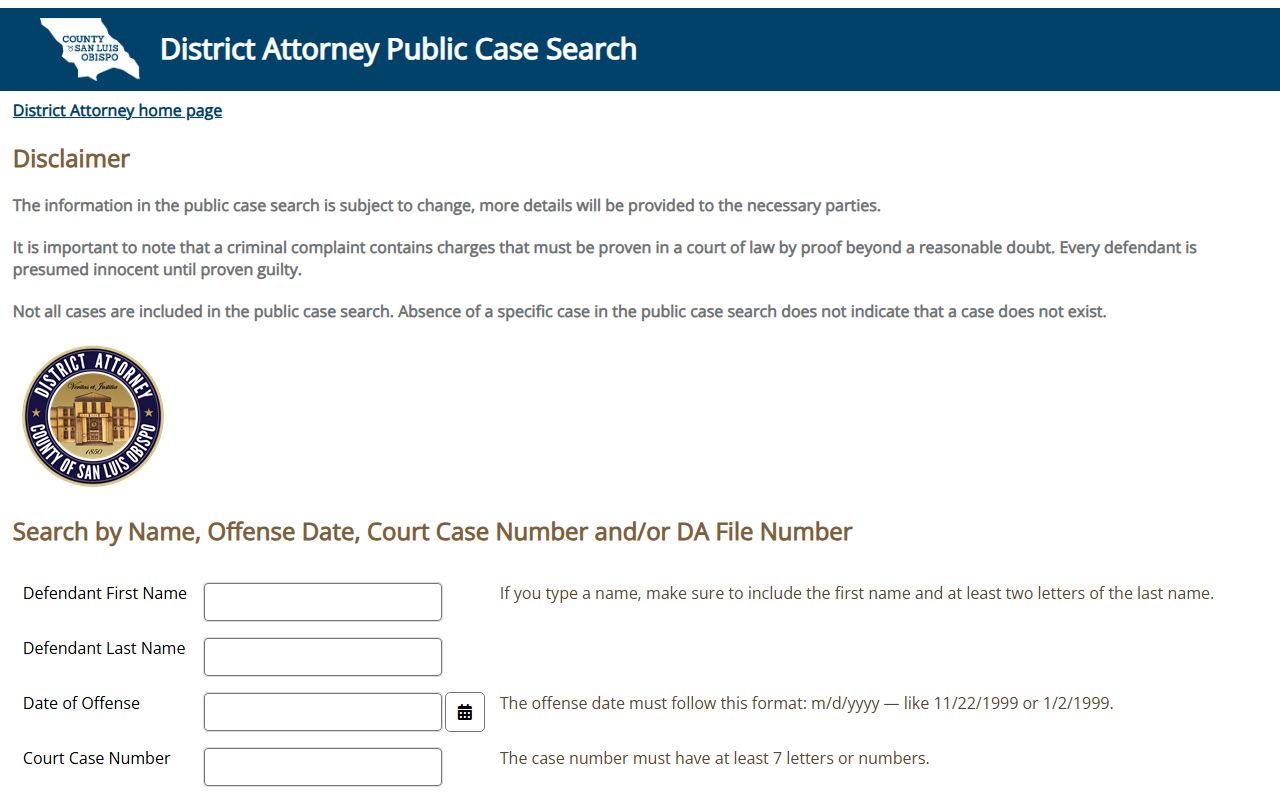
The DA search is useful after a jail arrest because it follows the prosecutor-side case rather than the jail's temporary booking display.
Find Court Records After Arrest
Start with the booking record only long enough to collect identifiers. The Booking Log may show a parent case number, case number, court docket number, next court date, court department, arrest location, arrest type, warrant number, warrant agency, bail, and charge details. Those fields are helpful search clues, but the jail does not control the formal court docket. The Superior Court directs public users to online case lookup through re:SearchCA, notes that remote access requires registration, and also makes courthouse kiosks available for case access.
- Open the Sheriff's current roster or Booking Log and write down the person's full name, booking number, arrest date, arresting agency, charge wording, court docket number, and next court date if shown.
- Search the DA Public Case Search by defendant name, offense date, court case number, or DA file number.
- Search the re:SearchCA court portal or use the Superior Court's courthouse kiosks when remote registration or remote-access limits block the record.
- Use the court's Request Court Records process for copies, certified copies, older files, or documents not shown online.
The DA search includes a clear warning: not all cases are included, absence of a case does not prove that no case exists, charges must be proven beyond a reasonable doubt, and every defendant is presumed innocent. California Rules of Court can also limit remote criminal access, so an online search can be incomplete even when a courthouse kiosk or clerk request has more information.
| Search Channel | Best Use After Arrest | Important Limit |
|---|---|---|
| Sheriff Who's in Custody | Current jail custody, booking charge, bail, inmate ID, booking number | Not a court docket and no court date was visible in the inspected roster profile |
| Booking Log | Recent 30-day booking data, court docket fields, warrant fields, arrest location when populated | A recent booking can remain listed even after release |
| DA Public Case Search | Filed prosecutor-side charges, case status, future court dates, event names | Not every case is included |
| Superior Court / re:SearchCA | Formal court case lookup and court-record access | Remote access requires registration and may be narrower than courthouse access |
Court and DA Search Fields
The DA case-search form has more specific validation rules than the jail roster. A name search requires defendant first name and at least two letters of the last name. A court case number must have at least seven letters or numbers. The offense date field uses an m/d/yyyy format and includes a date selector. The Superior Court lookup routes remote public access through re:SearchCA, where registration may be required before a party-name or case-number search can proceed.
| System | Field | Requirement or Format | Use |
|---|---|---|---|
| DA Public Case Search | Defendant First Name | Conditional for name search | Pair with last name to find prosecutor case entries |
| DA Public Case Search | Defendant Last Name | At least two letters for name search | Narrows defendant search results |
| DA Public Case Search | Date of Offense | m/d/yyyy | Useful when the arrest date is known from the Booking Log |
| DA Public Case Search | Court Case Number | At least seven letters or numbers | Connects a jail court-docket field to a prosecutor result |
| DA Public Case Search | DA File Number | Conditional search path | Useful when the DA file number is already known |
| Superior Court / re:SearchCA | Case or party search | Remote registration may be required | Finds the court-side docket or access path |
| Courthouse kiosk | Public terminal search | In-person access | Fallback when remote criminal access is limited |
Charging Documents After Arrest
A booking charge is an arrest-side allegation known to the jail at intake. The prosecutor's filed charge is the court-side allegation that starts or advances the criminal case. In San Luis Obispo County, the District Attorney reviews reports after arrest and decides whether to file a complaint, change the charge, decline the referral, or seek more investigation. Felony cases may later move through an information after preliminary hearing, and serious matters can proceed by indictment if a grand jury returns one.
| Complaint | Information | Indictment | |
|---|---|---|---|
| Filed By | District Attorney | District Attorney | Grand jury process |
| Common Use | Starts many criminal cases after arrest | Felony charging document after a preliminary hearing or holding order | Grand-jury charging document, often for serious matters |
| Connection to Booking | May match or differ from booking charges | May amend or refine earlier allegations | May bypass the ordinary complaint-to-preliminary-hearing path |
| Where to Check | DA search, court lookup, clerk records | Superior Court docket and clerk records | Superior Court docket and clerk records |
Charge Status After Arrest
Charges can change quickly after a San Luis Obispo County arrest. A roster charge can be only the intake charge known at booking. The DA may file it as written, amend it, reduce it, add different counts, dismiss a count, or decline prosecution. A Superior Court docket may then show hearing events, warrants, continuances, pleas, trial settings, dismissals, or sentencing entries. Read every charge line separately because one count can be pending while another has been dismissed or resolved.
| Status | What It Means |
|---|---|
| Pending | The filed charge is active and unresolved in the court case. |
| Amended / Reduced | The prosecutor or court record changed the allegation, often by replacing or lowering the original filed charge. |
| Dismissed | The charge was removed by prosecutor or court action and is not a conviction. |
| Declined | The DA chose not to file charges from the referred arrest or report. |
| Convicted | A plea, verdict, or judgment created a final adjudication of guilt on that count. |
| Acquitted | A not-guilty verdict resolved the charge in the defendant's favor. |
| Diversion | The case follows a conditional path that may lead to dismissal or relief if requirements are completed. |
| Bench Warrant | The court issued a warrant, often tied to failure to appear or failure to comply. |
Bond and Release After an Arrest
Local bail information starts with the jail and court, not with a background-check result. The Sheriff's FAQ explains bail as the full amount listed for the crime. Bail may be posted in U.S. currency, cashier's check, official bank check, certified check, or U.S. Postal Service money order made out to the San Luis Obispo County Sheriff's Office. Personal checks and credit cards are not accepted. For current bail information, the jail booking and visitation line is (805) 781-4600.
California bail law also matters. Penal Code section 1269b authorizes bail schedules and certain jailer releases, while Penal Code section 1275 lists factors courts consider in setting bail. In re Humphrey requires California courts to consider ability to pay and less restrictive alternatives before detaining a person solely because money bail cannot be paid. Even when a roster shows a bail amount, release can be blocked by a no-bail status, parole or probation hold, other-county hold, detainer, court paperwork delay, or state-prison transport after sentencing.
| Bond Type | How It Works |
|---|---|
| Cash Bail | The full bail amount is posted directly in an accepted form. |
| Surety Bond | A licensed bail bond agency posts bond for a fee or percentage, subject to agency terms and collateral. |
| Own Recognizance | The court releases the person based on a promise to appear, without requiring money bail. |
| Cite Release | The Sheriff's FAQ describes this as a release path generally used for fresh misdemeanor charges when jail criteria are met. |
| No-Bail Hold | Posting money will not produce release until the court or holding agency resolves the no-bail condition. |
Warrants That Lead to an Arrest
A warrant can turn a court record into a jail booking. The San Luis Obispo Superior Court has an official warrants page, but no public countywide active-warrant database was identified from the Sheriff or the court. For official local warrant routing, use the Superior Court's warrant guidance, the Sheriff's Records & Warrants unit at (805) 781-4588, and the jail roster only after the warrant has resulted in custody. The Booking Log XML can include WarrantNumber and WarrantAgency fields when populated, plus court docket and next court date fields, but blank fields should not be read as proof that no warrant exists.
If a San Luis Obispo County warrant has already caused an arrest, the question changes from "is there a warrant" to "where is the person in custody and what case follows." Check the county jail roster, the 30-day Booking Log, the DA search, and the Superior Court lookup. If the warrant is from another county, local release may depend on pickup or transfer from that outside jurisdiction, and the Sheriff's FAQ states that other-county pickup dates are not released.
Charges vs. Convictions
An arrest and a charge are not a conviction. The DA public case search itself warns that a criminal complaint contains charges that must be proven in court beyond a reasonable doubt and that every defendant is presumed innocent. That warning is central when reading San Luis Obispo County court records after an arrest. A person may have a booking record, a filed complaint, and future court dates without having been found guilty of anything.
| Charge | Conviction | |
|---|---|---|
| Stage | Accusation after arrest or prosecutor review | Final result after plea, verdict, or judgment |
| Burden of Proof | Based on arrest referral or probable cause standards | Beyond a reasonable doubt in criminal court |
| Where It Appears | Jail roster, Booking Log, DA search, court docket | Court disposition, sentencing record, criminal-history record if legally available |
| Public Meaning | Allegation only | Adjudicated outcome |
Sealed vs. Expunged Arrest Records
California record relief is specific. Penal Code section 851.91 creates a pathway to petition to seal arrest records when an arrest did not result in conviction, subject to statutory exclusions. Penal Code section 1203.4 can provide dismissal-style relief in eligible conviction cases, but it does not make every record disappear from every government or third-party system. Court access may also be limited by California Rules of Court, juvenile confidentiality, sealed case orders, law-enforcement exemptions, or ongoing investigation limits.
| Sealed | Expunged / Dismissal Relief | |
|---|---|---|
| Visibility | Hidden or restricted from ordinary public access by law or order | Often changes the public disposition or legal effect, depending on the statute used |
| Law Enforcement | May remain available for limited official purposes | May remain visible for specified official, licensing, or later-case purposes |
| Eligibility | California Penal Code section 851.91 applies to eligible arrests that did not result in conviction | California dismissal relief depends on conviction, sentence, supervision, and statutory exclusions |
| Practical Step | Use the court process and verify with the clerk | Use the court process and verify how the record is reported after relief |
Background Check Considerations
San Luis Obispo County court records after an arrest are public-record access tools, not a substitute for a legally compliant background-check process. Employment, tenant screening, credit, insurance, and other consumer-reporting uses are governed by the Fair Credit Reporting Act and related state rules. Casual court lookup can help identify a case path, but it should not be treated as a complete criminal-history report, a conviction record, or a screening decision source.
Important: Public-record lookup information is not a consumer report and must not be used for FCRA-covered screening decisions.
Restricted San Luis Obispo Court Records
Some records are not available through remote public search even when a booking occurred. Juvenile matters, sealed records, protected victim or witness information, certain dismissed or diverted matters, and ongoing investigations may be withheld or limited. California's Public Records Act generally supports access to state and local agency records, but law-enforcement arrest information can be withheld where disclosure would endanger an investigation, a witness, or another protected interest. Criminal remote-access rules can also mean that a courthouse kiosk or clerk request is the proper fallback after the online portal stops short.
For records not shown online, use the Sheriff's Records & Warrants unit for law-enforcement or adult booking records, the Superior Court record-request process for court files, and the DA public search for prosecutor-side case status. Keep the systems separate: the county roster answers current custody, the Booking Log answers recent booking, the DA search answers filed prosecutor case information, and the court record answers the formal case docket and disposition.